
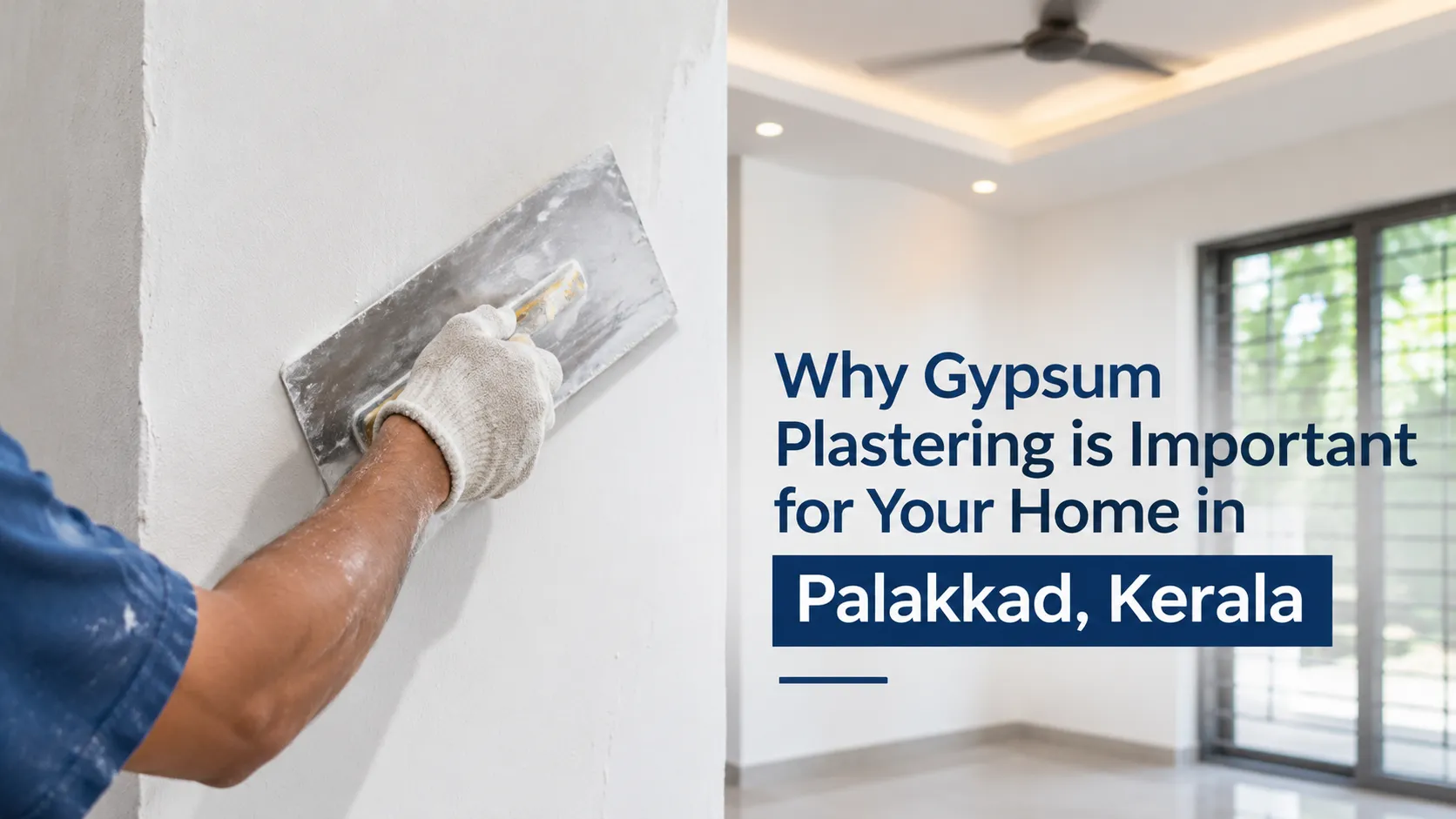
Gypsum plaster offers smoother walls, faster finishing, reduced plastering cracks and less construction time for modern homes in Palakkad. Discover its benefits, limitations and where it is best used in Kerala homes.
Why Gypsum Plastering Is Important for Homes in Palakkad, Kerala
When building a new home in Palakkad, Kerala, choosing the right wall finishing material is an important decision that influences the appearance, durability and finishing quality of your interiors. Traditionally, cement-sand plaster has been widely used for plastering walls. However, gypsum plaster has become a popular alternative for modern residential construction.
Gypsum plaster provides a smooth wall finish, reduces the need for extensive finishing work, saves time during construction and eliminates the need for conventional water curing. When used in the right areas and applied correctly, it can help create cleaner, more refined interiors for homes in Palakkad.
What Is Gypsum Plastering?
Gypsum plaster is a plastering material made primarily from gypsum, a naturally occurring mineral. It is processed into a fine powder and mixed with water before application to interior walls and ceilings.
Unlike conventional cement plaster, gypsum plaster can generally be applied in a single coat to create a smooth, even surface suitable for painting.
It is commonly used on:
- Brick masonry walls
- Concrete block walls
- AAC block walls
- Interior RCC surfaces, subject to proper surface preparation
- Interior ceilings
Gypsum plaster is primarily intended for dry interior applications. It should not be treated as a replacement for cement plaster in exterior walls or surfaces exposed to persistent moisture.
1. Creates Smooth and Premium-Looking Walls
One of the main reasons homeowners choose gypsum plaster is its smooth finish.
Traditional cement plaster often leaves a relatively rough surface that requires additional finishing, such as wall putty, before painting. Gypsum plaster can produce a finer, more uniform surface that helps achieve a clean appearance with suitable paint preparation.
This is particularly beneficial in modern Kerala homes featuring:
- Minimalist interior designs
- Contemporary wall colours
- Decorative lighting
- Wall-mounted furniture
- Large windows and natural lighting
- Modern living room and bedroom designs
Smooth walls help create a more refined interior appearance and improve the overall visual quality of a home's finishing work.
2. Helps Reduce Plastering-Related Shrinkage Cracks
Cracks appearing on newly plastered walls can affect the appearance of a house and may require repairs before painting.
Cement plaster can develop shrinkage cracks when factors such as incorrect mix proportions, excessive water, poor workmanship, inadequate curing or rapid drying affect the plaster.
Gypsum plaster generally experiences less drying shrinkage than conventional cement-sand plaster. This can reduce the risk of plaster-related shrinkage cracking when the material is properly selected and applied.
However, gypsum plaster cannot prevent every type of wall crack.
Cracks caused by structural movement, settlement, improper masonry construction, movement between different materials or problems in the building structure require proper investigation and correction.
Choosing gypsum plaster alone is not a guarantee of crack-free walls.
3. Saves Construction Time
Time is an important factor when building a house.
Conventional cement plaster requires water curing to support proper cement hydration. This adds time, labour and water consumption to the construction process.
Gypsum plaster does not require conventional water curing. After application, it needs appropriate drying conditions before subsequent finishing work.
This can help streamline the interior finishing schedule and reduce delays associated with plaster curing.
For homeowners constructing houses in Palakkad, faster interior finishing can help coordinate painting, electrical finishing, interior works and other activities more efficiently.
4. Reduces Water Consumption During Construction
Water management is an important consideration at every construction site.
Cement plaster requires regular water curing. Gypsum plaster, on the other hand, does not require this conventional curing process.
Using gypsum plaster for suitable interior areas can reduce the water required specifically for plaster curing.
This can be beneficial for:
- Reducing construction water usage
- Simplifying site management
- Minimising curing-related labour
- Keeping interior construction activities more organised
It is important to understand that gypsum plaster still requires water for mixing and proper application. Its water-saving advantage comes mainly from eliminating conventional curing.
5. Helps Achieve Better Interior Finishing
The final appearance of a house depends on several stages of construction, including masonry alignment, plastering, painting and interior design.
A smooth plastered surface provides a better foundation for:
- Interior paint finishes
- Feature walls
- Decorative lighting
- Wall panelling
- Wallpaper, where suitable
- Contemporary interior designs
Gypsum plaster can help reduce the surface irregularities that are visible under artificial lighting or natural light entering through windows.
When walls are properly prepared and finished, the result can be a more consistent and professional appearance throughout the home.
6. Can Help Improve Indoor Comfort
Gypsum plaster has properties that can contribute to thermal and acoustic performance. However, the actual improvement in a home's comfort depends on the complete wall assembly, building orientation, ventilation, insulation, windows, roofing and other construction details.
In Palakkad, where temperatures can become particularly high during certain periods of the year, homeowners should focus on an overall climate-responsive design rather than expecting plaster alone to significantly cool a house.
Good architectural planning, shading, roof insulation where appropriate, ventilation and suitable building materials play a more comprehensive role in indoor comfort.
Gypsum plaster can be one component of a well-planned interior finishing system.
7. Offers a Lighter Plastering Solution
Gypsum plaster is generally lighter than conventional cement-sand plaster at comparable thicknesses.
This can reduce the dead load contributed by plastering, particularly when used on suitable ceilings and interior surfaces.
While plaster weight is only one part of the building's total structural load, material selection can contribute to more efficient construction when considered during the design and planning stage.
The actual weight depends on the gypsum plaster product, thickness and application method.
8. Provides a Cleaner Construction Process
Gypsum plaster is commonly supplied as a ready-to-use dry powder that is mixed with water at the site.
Compared with conventional cement-sand plastering, it can reduce the need for storing and handling sand for the plastering operation.
This may help create:
- Cleaner interior work areas
- Less material handling
- Better finishing efficiency
- Easier coordination with other construction activities
The benefits depend on proper storage, mixing, application and site management.
Gypsum Plaster vs Cement Plaster: Which Is Better for Your Home?
Both gypsum plaster and cement plaster have important roles in residential construction. The right choice depends on the location of the surface, exposure to moisture, required finish and construction specifications.
Feature| Gypsum Plaster| Cement Plaster
Surface finish| Smooth, fine finish| Generally rougher
Conventional water curing| Not required| Required
Interior dry walls| Suitable| Suitable
Exterior walls| Generally unsuitable| Suitable
Persistent moisture exposure| Not suitable for ordinary gypsum plaster| More suitable
Shrinkage| Generally lower| Can develop shrinkage cracks
Finishing requirements| Often needs less surface finishing| May need putty or additional finishing
Construction process| Faster interior finishing| Requires curing and drying time
Typical applications| Dry interior walls and ceilings| Exterior walls and moisture-exposed areas
The best approach for many homes is not necessarily choosing one plastering material for the entire building. Instead, the material should be selected according to the requirements of each area.
Where Should Gypsum Plaster Be Used in a Kerala Home?
Gypsum plaster is generally suitable for dry interior areas such as:
- Living rooms
- Bedrooms
- Dining rooms
- Dry interior corridors
- Interior ceilings
- Suitable interior wall surfaces
Areas that experience direct water exposure or persistent moisture require a different approach.
Where Gypsum Plaster Should Generally Be Avoided
Ordinary gypsum plaster should generally not be used on:
- Exterior walls exposed to rain
- Bathrooms and shower areas
- Wet utility areas
- Walls affected by water leakage
- Damp walls caused by moisture penetration
- Areas with persistent condensation or moisture
For these locations, cement-based plaster and appropriate waterproofing systems are generally more suitable.
Is Gypsum Plaster Suitable for Palakkad's Climate?
Palakkad experiences a tropical climate, with hot periods and seasonal rainfall. Homeowners may understandably have concerns about using gypsum plaster because of Kerala's humidity and monsoon conditions.
The important factor is not humidity alone but the actual moisture exposure of the plastered surface.
Gypsum plaster can be suitable for interior spaces in Kerala when:
1. The wall is free from active water leakage.
2. The masonry has dried sufficiently before plastering.
3. The application area is suitable for the selected gypsum plaster product.
4. Exterior walls are protected against rainwater penetration.
5. Bathrooms and other wet zones are treated using appropriate materials.
6. The product is applied according to the manufacturer's instructions.
7. Proper drying and ventilation are maintained before painting.
For homes in Palakkad, selecting the correct material for each area and ensuring proper workmanship are more important than choosing a material simply because it is marketed as modern.
Does Gypsum Plaster Cost More?
The cost of plastering depends on several factors, including:
- Area to be plastered
- Wall condition
- Plaster thickness
- Product quality and brand
- Labour availability
- Surface preparation requirements
- Additional finishing materials
- Local material transportation costs
Gypsum plaster may have a different initial material and application cost compared with cement plaster.
However, homeowners should compare the complete finishing cost rather than looking only at the plaster material price.
The overall cost comparison should consider labour, curing requirements, finishing work, material wastage and the time required to complete the plastering stage.
A proper project-specific estimate is necessary to determine which option is more economical for a particular house.
Why Proper Application Matters
Even high-quality gypsum plaster may not deliver the expected results if the application is not carried out correctly.
Important factors include:
- Proper surface preparation
- Correct water-to-plaster mixing
- Appropriate plaster thickness
- Correct bonding and treatment of different surface materials
- Suitable mesh reinforcement at vulnerable junctions where required
- Proper finishing technique
- Adequate drying before painting
- Protection from moisture
The junction between RCC columns, beams and masonry walls deserves particular attention because different materials can move differently. Appropriate detailing and reinforcement methods may help minimise cracks at these junctions.
Choosing the Right Plaster for Your Home
When planning a house in Palakkad, plastering decisions should be made as part of the overall construction and finishing plan.
Gypsum plaster can be an excellent choice for suitable interior areas where homeowners want smooth walls, efficient finishing and reduced curing requirements.
Cement plaster remains important for exterior surfaces and areas exposed to moisture.
Rather than using one material everywhere, a well-planned home can use different plastering systems according to the function and exposure of each space.
Conclusion
Gypsum plastering is an important option in modern residential construction because it offers smooth interior finishes, reduced plaster-related shrinkage, faster finishing work and the advantage of not requiring conventional water curing.
For homes in Palakkad, Kerala, it can be a practical solution for suitable dry interior walls and ceilings when the material is selected carefully and applied correctly.
At Losung Builders, thoughtful material selection, proper construction planning and quality workmanship are essential considerations when building a home. Choosing the right plastering system is one of the many decisions that contribute to the quality of a home's final finish.
A beautiful home is not just about its architectural design. The quality of every finishing detail matters.
---
Frequently Asked Questions
1. Is gypsum plaster better than cement plaster for homes in Kerala?
Gypsum plaster is generally suitable for dry interior walls and ceilings because it offers a smooth finish and does not require conventional water curing. Cement plaster is more suitable for exterior walls and moisture-exposed areas. Both materials have their own applications.
2. Does gypsum plaster crack?
Gypsum plaster generally experiences less shrinkage than conventional cement-sand plaster. However, cracks can still develop because of structural movement, settlement, poor surface preparation, improper application or movement between different building materials.
3. Can gypsum plaster be used on exterior walls?
Ordinary gypsum plaster is generally not recommended for exterior walls because exposure to rain and persistent moisture can damage it. Cement-based plaster is generally more appropriate for external surfaces.
4. Can gypsum plaster be used in bathrooms?
Ordinary gypsum plaster is generally unsuitable for surfaces exposed to frequent water contact. Bathroom walls and wet areas should use appropriate plastering and waterproofing systems.
5. Does gypsum plaster require water curing?
No. Gypsum plaster does not require the conventional water-curing process used for cement plaster. However, proper mixing, application and drying are essential.
6. Is gypsum plaster suitable for Palakkad's weather?
Yes, gypsum plaster can be suitable for dry interior spaces in Palakkad when the walls are properly prepared and protected from moisture. It should not be used on surfaces with persistent dampness or direct water exposure unless a specific product and system are designed and approved for that application.
7. Can gypsum plaster reduce painting costs?
Gypsum plaster can provide a smoother surface and may reduce the amount of additional surface finishing required. The actual painting cost depends on the plaster finish, primer, paint system and workmanship.
8. Is gypsum plaster suitable for ceilings?
Gypsum plaster can be suitable for interior ceilings, including appropriate RCC surfaces, when surface preparation and application are carried out correctly.
9. Which plaster gives a better finish for modern homes?
Gypsum plaster is often preferred for achieving a smooth, refined interior finish. Cement plaster can also produce good results when properly applied and finished, but it may require additional surface preparation.
10. Should gypsum plaster be used throughout the house?
Not necessarily. A practical approach is to use gypsum plaster in suitable dry interior areas and cement-based plaster in exterior and moisture-exposed areas. Material selection should be based on the function of each space.